
Learning Spanish While Watching World Cup 2026.
What happens when the beautiful game meets the beautiful language?

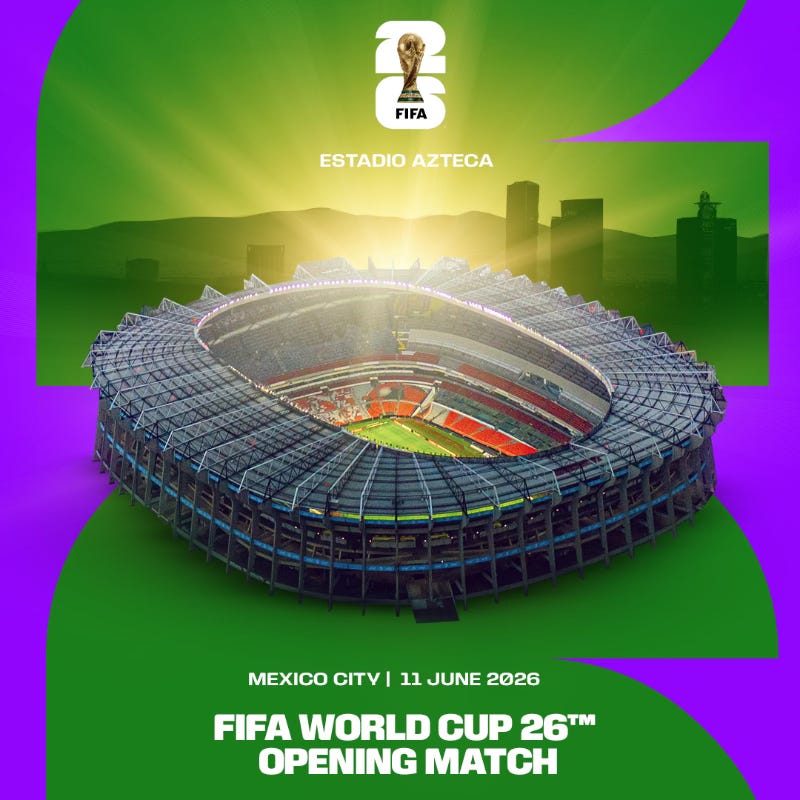
Whether you’re a football fan or not, World Cup 2026 is here. The tournament kicks off later today when co-hosts Mexico take on South Africa at dizzyingly high altitudes in Mexico City.
If, like me, you’re a football fan who is also constantly trying to improve your Spanish, you might be wondering whether you can get in some extra input practice by tuning into Spanish-language commentary of the tournament. Perhaps you might even find that in five weeks, when the winner is crowned, you have a solid working knowledge of el fútbol and an extra 150+ hours of Spanish language input. It’s a tempting idea. But like a striker one-on-one with the keeper, the outcome is far from guaranteed.
Here’s a look at the pros, the cons, and some alternatives for getting real Spanish input while the tournament runs.
Pros - or Why Football Commentary Can Be a Surprisingly Good Teacher
1. Repetition, Repetition, Repetition
Language acquisition thrives on repeated exposure to the same words in context, and football commentary delivers this in spades. Phrases like “fuera de juego” (offside), “tiro a puerta” (shot on goal), “el árbitro” (the referee), and “¡qué golazo!” (What a great goal!) will be drilled into your ears dozens of times per match, across dozens of matches. That kind of high-frequency repetition is exactly what helps vocabulary stick.
2. International Words You Already Know
Football has its own global vocabulary, and a surprising amount of it transfers directly. Words like penalti, gol, fútbol, estadio, and even offside are either identical or near-identical in Spanish. These cognates give you a foothold from the very first minute of the game, and that feeling of recognising words builds the confidence to keep listening.
3. The Emotional Context Locks Words In
Memory and emotion are tightly linked. The dramatic peaks and valleys of a World Cup match, for example, the tension of a penalty shootout, the despair of a last-minute equaliser, etc., help to create emotionally charged moments that cement vocabulary far more effectively than flashcards ever could.
4. It’s Built-In Daily Listening Practice
During the group stage alone, there are a ridiculous 48 matches. For a few weeks, you have a ready-made reason to sit down and immerse yourself in Spanish audio for 90 minutes at a time. For many learners, finding the motivation to practise consistently is the hardest part. And the World Cup solves that problem entirely.
5. Visual Context Does a Lot of the Heavy Lifting
Unlike a podcast or radio programme, football on television gives you a constant visual feed to anchor the language. You don’t need to understand every word to follow what’s happening. When the camera cuts to a coach gesticulating furiously on the touchline and the commentator says “el entrenador está muy enfadado”, you can guess the meaning. This kind of comprehensible input through context is an effective way to learn. When I watch how my two-year-old daughter picks up vocabulary quickly, it’s always with a visual or action attached to the word.
6. Exposure to Multiple Spanish Dialects
Depending on which broadcasters you tune into, you’ll encounter Spanish from Spain, Mexico, Argentina, Colombia, and beyond. While this can be confusing (more on that below), it can also be a genuine advantage. You could think of it as developing an ear for the diversity of the Spanish-speaking world, rather than training yourself to understand only one accent.
Cons - or Why This Process Might Drive You Mad
1. The Pace Is Punishing
Commentators, especially in Latin American Spanish, speak muy rapido. Rapidissimo! Excitement accelerates speech, long player names get swallowed whole, and sentences blur into a continuous stream of sound. For learners below a solid B1 level, rapid-fire delivery stops being comprehensible input and becomes unintelligible sound with occasional recognisable words. If your level isn’t intermediate, you might find yourself expending enormous mental energy for limited return.
2. The Vocabulary Is Highly Specialised
Football Spanish is its own dialect. Mastering fuera de juego won’t help you book a restaurant, ask for directions, or have a conversation with a local. The specialised lexicon (words like pelota dividida, jugada a balón parado, presión alta) is useful precisely within football and almost nowhere else. If your goal is conversational Spanish, you’re building a very narrow vocabulary base.
3. Slang and Regional Expressions Are Everywhere
Each Spanish-speaking country has its own football slang, and commentators use it liberally. Argentine commentary is particularly colourful, and almost like a different language. Mexican commentary has its own flavour. Spanish commentary from Cadena SER or Movistar+ will throw in idioms that even intermediate learners struggle with (similar to those we hear regularly in English). Without any prior knowledge, these expressions are impenetrable.
4. No Subtitles
Unlike a TV drama or a YouTube video, live football doesn’t have a subtitle track to fall back on. Or if it does, it’s so far behind the action of the game as to be almost useless. This makes it a passive, not active, learning experience for most beginners.
5. Commentary Is Not Conversation
Almost everything you hear in a match is one-directional, formal commentary or post-match interview in Spanish. It doesn’t reflect how people actually speak in everyday situations. You could watch every match of the tournament and still struggle to have a simple conversation.
6. Cognitive Load Competes With Enjoyment
If you’re genuinely invested in the match, your brain is focused on the football. Learning a language requires active processing, and it’s very hard to do both simultaneously. You may end up neither enjoying the game fully nor learning much Spanish.
The Alternative: Spanish Football Podcasts
If you want comprehensible input about the World Cup while actually making progress with Spanish, podcasts might be a better option. The pace is controlled, the vocabulary tends to be more deliberate and conversational, and you can pause, rewind, and replay at will.
In the buildup to the World Cup, I’ve been listening to:
Fútbol de Primera with Andrés Cantor (Sonoro)
The gold standard for World Cup Spanish. Andrés Cantor, the Argentine-American broadcaster whose elongated “¡GOOOOOL!” shout has been bouncing around the internet for decades, hosts this daily podcast from Miami, with full dedicated coverage of the 2026 tournament. The show covers news, analysis, and debate across Liga MX, MLS, and the World Cup, and Cantor’s passion and clarity make it more accessible than most native-speaker football content, even at speed. His Latin American Spanish is clear and expressive, and this is a model for learners who want to understand how football sounds when someone truly loves it.
Watching the World Cup in Spanish is a supplement rather than a syllabus. If you’re already at an intermediate level, immersing yourself in Spanish commentary will sharpen your ear, introduce you to new vocabulary, and deepen your connection to the language. If you’re a beginner, it will mostly be an enjoyable but linguistically bewildering experience. Be warned.
The real gains come from pairing the matches with active learning: jotting down phrases you hear repeatedly, looking them up afterwards, and swapping live commentary for podcasts whenever you want genuine comprehensible input.
Amigos, the World Cup only comes around every four years, so certainly use the excitement around the tournament (one that’s being co-hosted in a Spanish-speaking country) as motivation to boost your language acquisition…just don’t expect to learn too much Spanish from watching football alone.
Let me know if you will be tuning into World Cup 2026, either in Spanish or in your own mother tongue.
¡Hasta la próxima!
When I was traveling in South America and there were matches on TV, I found that the commentators, despite speaking fast, were easy to understand because their annunciation was very clear. It was always encouraging to understand at least axlittle bit of what they were saying.
Love this! I remember that while watching my first World Cup in Spanish many years ago, it seemed impossible to distinguish the players' names from the rest of the commentary, and the only thing I understood was GOOOOOOOOOOOL. But you're so right about the emotion locking it in. This was an amazing Mundial, so grateful to have lived it.